
Consent under review
ExampleConsent first
A legal basis
Opt-out allowed
The reasoning, in plain English
Before the first email
Free reference card and PDF
For: anyone emailing people in another country, or checking a list before a send. A shop with buyers abroad, a newsletter with readers everywhere, a team asked "are we allowed to email these people?"
The 60-second answer
The law follows the reader, not you. A US business emailing someone in the EU must meet GDPR. One send can fall under several laws at once.
There are two models. The US lets you send until someone opts out. The EU, Canada and the Asia Pacific laws on this card want consent first.
Meet the strictest and you meet the rest. Applying GDPR or CASL rules to everyone is the simpler path, and it fits most programs. GDPR compliance satisfies CAN-SPAM, but not the other way round.
Every explanation on this page comes from the Email Almanac, our own library of more than 4,000 answers about email. You do not have to buy anything to read it.
Which case are you?
Type the country your reader is in, or pick one. The card shows what the law there asks before the first email.
Answer here and your row lights up, with what to do first. The PDF has every row and the full guide.
Not on this card yet. We will not guess. Tell me when it is added
Read in your browser only. Nothing you type or pick is sent to us or stored.Consent under review
ExampleThe reasoning, in plain English
Before the first email
Your plan
| Where your reader is | Law | Before the first email | Unsubscribe | What you must provide | Top fine |
|---|---|---|---|---|---|
| EU and EEA | GDPR | Opt-in. A clear action, freely given, specific and informed. Pre-ticked boxes and silence do not count | Without unreasonable delay, read as days, not weeks. Leaving must be as easy as joining | Proof of when and how each person agreed | Up to €20 million or 4 percent of global turnover, whichever is higher, for consent failures |
| United Kingdom | PECR, with UK GDPR | Consent for people, with a soft opt-in for your own customers about similar products, if they could opt out when you took the address. Company addresses such as info@ can be mailed without consent first, but a named person's work address counts as a person | An easy unsubscribe in every message | Who you are, contact details that work, and a valid opt-out | Not in the Almanac yet |
| United States | CAN-SPAM | No consent needed first. You may send until someone opts out | Honored within 10 business days, and the link must work for 30 days after the send | Honest headers and subject line, a note that it is an advertisement, a physical postal address, a working unsubscribe | Up to $53,088 per email |
| California | CCPA, as amended by CPRA | No consent needed to send. It governs what you do with the data afterwards | Not in the Almanac yet | A Do Not Sell or Share link if you share data with ad networks, and real deletion when someone asks, not only suppression | Not in the Almanac yet |
| Canada | CASL | Express consent, or implied consent for 24 months after a purchase or 6 months after an inquiry | Processed within 10 business days | Who is sending, contact details that work for 60 days after the send, a working unsubscribe | Up to $10 million CAD per violation for a business |
| Brazil | LGPD | A legal basis, usually consent or legitimate interest. Consent means a positive action for a specific purpose, never a pre-ticked box | Consent can be withdrawn at any time, as easily as it was given | A plain privacy notice in Portuguese, and a way to honor each person's rights | Up to 2 percent of Brazilian revenue, capped at 50 million reais per violation |
| Australia | Spam Act 2003 | Consent, express or inferred. Inferred consent does not expire while the relationship lasts | A working unsubscribe | Who is sending | Up to AUD 2.22 million a day for serious breaches |
| Singapore | PDPA | Consent, and a check of the national Do Not Call Registry before you send | Not in the Almanac yet | Who is sending | Up to $1 million SGD for organisations |
| Japan | Act on Regulation of Transmission of Specified Electronic Mail | Opt-in for most commercial messages | Not in the Almanac yet | Who is sending | Can include criminal liability for individuals |
| India | DPDP Act 2023 | Consent, with notice and a stated purpose | Not in the Almanac yet | Rights to access, correction and erasure | Still being defined |
Data requests: under GDPR a person can ask what you hold about them, and you answer within one month, free of charge. That can stretch by two more months for complex cases if you tell them in the first month. UK GDPR is the same. CCPA allows 45 days, plus 45 more.
This card is about email, not legal advice. Email law is complex and varies by country. If you are unsure about your own setup, talk to someone who practises email law where you send.
What this means for your send
| Your situation | Do this first |
|---|---|
| Your list has readers in more than one country | Either apply the strictest rules (GDPR or CASL) to everyone, or split the list by country at signup and apply each country's rules. The first is simpler and fits most programs |
| You only have US-style opt-out on file, and you mail people in the EU, Canada or Brazil | The EU and Canada want consent before the first email, and Brazil wants a documented legal basis, usually consent. Meeting CAN-SPAM does not meet GDPR |
| You cannot show when and how someone signed up | From now on, keep for every signup: the address, the time and its time zone, the IP, the form or page, the exact words shown with the privacy policy version, and the tick or click itself. Under GDPR you must be able to show consent |
| You are choosing single or double opt-in | GDPR does not require double opt-in. Single opt-in with a timestamped record of the person ticking an unticked box can meet it. Double opt-in gives stronger proof if consent is ever challenged |
| Canadian contacts on implied consent | Check each clock: 24 months from a purchase, 6 months from an inquiry. Sending email does not reset it. Ask for express consent before it runs out |
| Someone unsubscribed and you want them back | Waiting does not refresh consent. Only they can opt in again, through a new signup. Keep a permanent suppression list so an upload never re-adds them |
| Someone asks to be deleted | An unsubscribe is not a deletion request. Keep the address on your suppression list to honor the opt-out, with only the address, the date and the reason. A deletion request is separate and has its own deadline |
| Your automations run off a different list from your campaigns | Sync unsubscribes at once, not hourly or nightly, check consent at each send rather than only when someone enters a flow, and make every flow exit on an unsubscribe |
Worked example. Skipper Mako runs Pearl Diver Travel (pearl-diver.example) and emails past and future travellers in the US, Canada, Germany and Brazil. Skipper reads the Americas and Europe rows of the card. A Canadian who asked for a quote eight months ago and never booked is past the 6-month implied consent window, so Skipper does not mail them unless they opt in. The old German signup form had a pre-ticked box, which is not valid consent under GDPR. Skipper switches every form to an unticked box, starts keeping the signup records, and applies the GDPR rules to the whole list rather than running four sets of rules.
Review My Emails
You sign up, upload your list and get every address back with one decision and the reason, in plain English. Big lists take a while, so we email you when yours is ready.
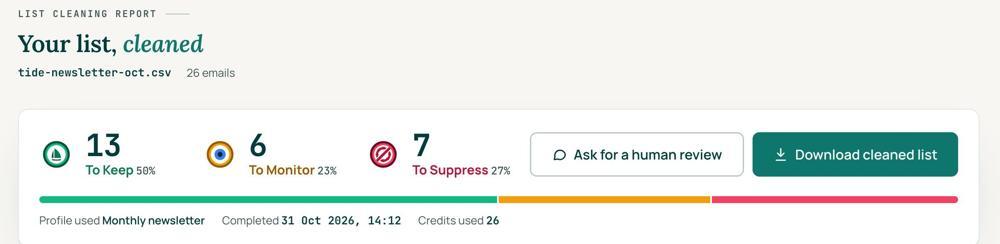
 To KeepSend to it.
 To MonitorSend carefully and watch what happens.
 To SuppressStop sending to it, and keep the record of who you stopped emailing.
Your first 1,000 are free
Create an account and your first 1,000 addresses are free. No card is needed to sign up. After that you pay for the size of your list, from $0.0080 an address down to $0.0026 at volume, with an $8 minimum. There is no subscription and no monthly minimum.
Human Review
If you want a person to look, ask for a Human Review from your report, and Yanna-Torry goes through your list herself.
Your next step. Consent tells you that you may email someone. It does not tell you the address still works or is safe to send to. Once you know who gave you consent, upload the list and clean your first 1,000 addresses free at reviewmyemails.com/get-started. Cleaning never turns a list without consent into one with consent. Questions about a send or where a list came from? Ask the free SOS line at reviewmyemails.com/sos. A real person answers, with no pitch.
List cleaning does not fix SPF, DMARC, MX or blocklist problems. Those live in your sending setup, and they are a different job. A blocklist listing measures your sending, so it is never a reason to suppress anyone on your list. And nobody can promise you the inbox, so we do not.
Yanna-Torry Aspraki, Review My Emails
Email SOS Hotline, free
For those problems there is the Email SOS Hotline, our free help line. Tell Yanna-Torry what is going on and she will tell you what she would do. She reads every message herself and replies within 48 to 72 hours, with no pitch.
Ask the free SOS lineFree PDF, 52 pages
 Trust beats tactics™
Founded in 2020, based in Bolton, United Kingdom.
reviewmyemails.com/resources/email-consent-laws-compared?c=web-p10-r07pdf · v1.1
Spotted something out of date?